Driving innovation across 20+ industries with 500+ scalable digital solutions.  EXPLORE OUR IMPACT Driving innovation across 20+ industries with 500+ scalable digital solutions.  EXPLORE OUR IMPACT Driving innovation across 20+ industries with 500+ scalable digital solutions.  EXPLORE OUR IMPACT Driving innovation across 20+ industries with 500+ scalable digital solutions.  EXPLORE OUR IMPACT
Shopify vs Custom Storefront in 2025: A Practical Decision Framework
E-Commerce May 5, 2026 · 7 min read

Shopify vs Custom Storefront in 2025: A Practical Decision Framework

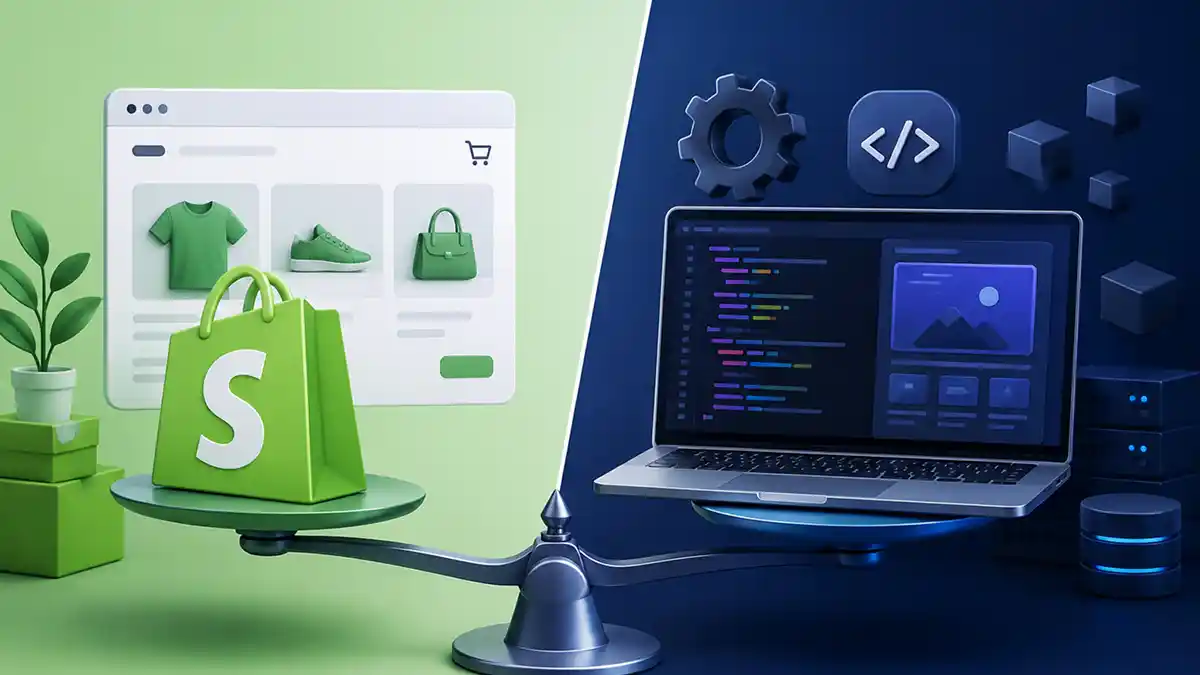
We've built both at scale. This isn't a feature comparison — it's a decision framework for founders and CTOs based on team size, expected GMV, and product complexity.

t
techlumas
Techlumas Engineering Team
Share Tweet

Introduction

Choosing the right eCommerce platform is a critical decision that directly impacts scalability, performance, and long-term business growth. In 2025, businesses are increasingly evaluating whether to use platforms like Shopify or invest in a fully custom storefront.

There is no one-size-fits-all answer. The right choice depends on your business model, technical requirements, growth plans, and operational complexity. This guide provides a practical framework to help you make the right decision.

Understanding the Two Approaches

Shopify is a hosted eCommerce platform that enables businesses to launch and manage online stores quickly with minimal technical effort. It provides built-in tools for payments, inventory, security, and hosting.

A custom storefront, on the other hand, is built from scratch or using frameworks such as headless commerce architectures. It offers complete flexibility in design, functionality, and integrations but requires higher development and maintenance effort.

Speed to Market

Shopify is designed for rapid deployment. Businesses can launch a fully functional store within days or weeks using pre-built themes and apps.

Custom storefronts require more time due to design, development, and testing cycles. However, they provide a tailored experience that aligns exactly with business requirements.

If speed is your priority, Shopify is the stronger option. If long-term customization matters more, a custom build is worth the investment.

Customization and Flexibility

Shopify offers a wide range of themes and plugins, but customization is ultimately limited by platform constraints. Advanced requirements may require workarounds or third-party apps.

Custom storefronts provide complete control over user experience, backend logic, and integrations. This makes them ideal for businesses with unique workflows or complex product offerings.

For standard eCommerce use cases, Shopify is sufficient. For highly differentiated products or experiences, custom development is more suitable.

Performance and Scalability

Shopify handles hosting, security, and performance optimization out of the box. It scales well for most small to mid-sized businesses and even many large brands.

Custom storefronts can be optimized for high performance and scalability, especially with modern architectures such as headless commerce. However, this requires proper infrastructure planning and engineering expertise.

If you want simplicity and reliability, Shopify is a strong choice. If you need fine-grained control over performance, a custom solution provides more flexibility.

Cost Considerations

Shopify follows a subscription-based pricing model with additional costs for apps, themes, and transaction fees. It offers predictable upfront costs but can grow over time as the business scales.

Custom storefronts involve higher initial development costs but may offer better cost control in the long term, especially for businesses with complex needs or high transaction volumes.

Shopify is generally more cost-effective for startups and small businesses. Custom solutions are better suited for enterprises or businesses with specific requirements.

Integrations and Ecosystem

Shopify has a large ecosystem of plugins and integrations, making it easy to connect with payment gateways, marketing tools, and logistics providers.

Custom storefronts allow integration with any system, including internal tools, legacy systems, and advanced third-party services. This provides unmatched flexibility but requires development effort.

Maintenance and Ownership

Shopify manages hosting, updates, and security, reducing operational overhead. This allows businesses to focus on growth rather than technical maintenance.

Custom storefronts require ongoing maintenance, including updates, security patches, and infrastructure management. However, they offer full ownership and control over the platform.

Decision Framework

Choose Shopify if:

  • You need to launch quickly
  • Your requirements are standard or moderately complex
  • You prefer a managed, low-maintenance solution
  • You want predictable upfront costs

Choose a Custom Storefront if:

  • You require deep customization and unique workflows
  • You need full control over performance and architecture
  • You plan to scale with complex integrations
  • You are building a differentiated or enterprise-level product

Real-World Perspective

In 2025, many businesses are adopting a hybrid approach. They start with Shopify to validate their market and then transition to a custom or headless architecture as they scale and require more flexibility.

This phased strategy reduces risk while enabling long-term growth.

Conclusion

Both Shopify and custom storefronts are powerful options, but they serve different purposes. The right choice depends on your current stage, technical needs, and long-term vision.

Making the right decision early can save significant time, cost, and complexity in the future.

Share Article

Share on LinkedIn Share on Twitter

Article Info

Category E-Commerce
Read time 7 min
Published
Author techlumas

Have a project in mind?

Our team responds in under 2 minutes.

Start a Conversation →
Keep Reading

Related Articles

All Articles →
Get Started

Transform Your Idea Into
a Digital Product

Share your requirements. We will understand your goals and build a custom plan.

Fast 2-minute response, fully NDA-protected
Free consultation with senior architects
Project estimate within 48 hours
Engineers working in your timezone
Clutch
Top 2024
4.9 / 5
500+ Reviews
ISO 27001
Certified

Share Your Requirements

Our team responds in under 2 minutes.

2-minute response · NDA-protected · No obligation

We're Local Where It Matters

With offices across 5 countries, our teams are always close to our clients — delivering world-class software from every timezone.

India (HQ) flag
HQ

India (HQ)

Noida, Uttar Pradesh

A-41, Sector 64, Noida — 201301
+91 120 456 7890
Mon–Sat · 9:00 AM – 7:00 PM IST
United States flag

United States

New York, NY

250 Park Avenue, Suite 1800, NY 10177
+1 646 123 4567
Mon–Fri · 9:00 AM – 6:00 PM EST
United Kingdom flag

United Kingdom

London, England

1 Canada Square, Canary Wharf, E14 5AB
+44 20 7946 0321
Mon–Fri · 9:00 AM – 6:00 PM GMT
Dubai flag

Dubai

Dubai, UAE

DIFC Gate District, Level 6, Dubai
+971 4 888 0000
Sun–Thu · 9:00 AM – 6:00 PM GST
Netherlands flag

Netherlands

Amsterdam

Herengracht 420, 1017 BZ Amsterdam
+31 20 555 0100
Mon–Fri · 9:00 AM – 6:00 PM CET