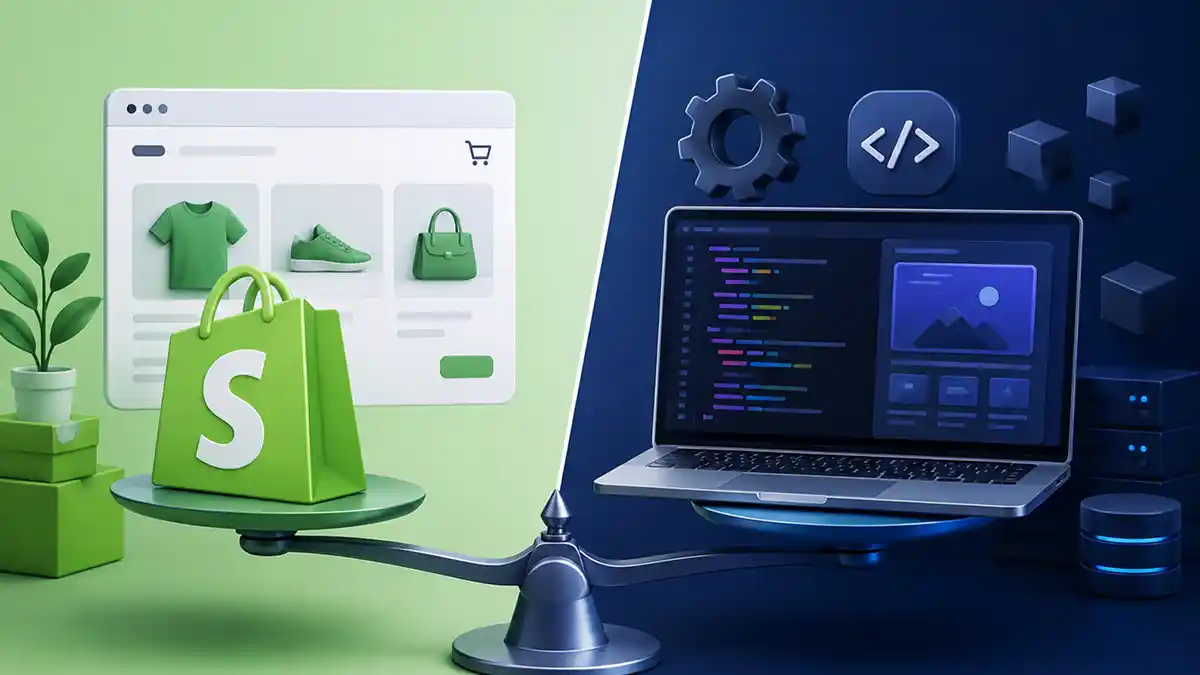
Whether to build on Shopify or invest in a custom commerce stack comes up in almost every e-commerce engagement we take on. The honest answer depends on three factors — not a feature checklist.
The three options, briefly
Shopify gives you a hosted store with themes, checkout, payments and an app marketplace. Headless Shopify keeps Shopify for products, cart and checkout but replaces the storefront with one you build yourself. A custom stack means you build or assemble everything, and own all of it.
Factor 1: Expected transaction volume
At lower and mid volumes, Shopify is hard to beat on time-to-market and total cost. At very high GMV, platform fees and flexibility limits start to justify a custom or headless build.
Compare total cost, not the subscription price. Include transaction fees, the monthly cost of every app you rely on, and development time, against the engineering salaries a custom platform requires.
Factor 2: Catalogue and workflow complexity
Standard products and checkout fit Shopify well. Complex configurators, B2B pricing rules, or unusual fulfilment logic push you toward custom.
A practical test: list the things your business does that a normal shop does not. If the list is short, extensions will cover it. If it describes your whole operation, you will spend your time working around the platform.
Factor 3: Engineering capacity
A custom stack is only an asset if you can maintain it. Without a capable team, Shopify plus targeted extensions is usually the smarter bet.
Custom means you are responsible for security updates, uptime, payment compliance and every integration, permanently. That is a standing team, not a one-off project.
When headless is the right middle path
Headless suits brands that have outgrown themes but not the platform: they want full control of the storefront experience and speed, while keeping a proven checkout and back office. It costs more to build and run than a theme, so it should solve a real limitation, not a preference.
Signs you have outgrown standard Shopify
- You are paying for many apps to patch around missing behaviour.
- Page speed suffers because of the scripts those apps add.
- Pricing or catalogue rules cannot be expressed without manual work.
- You need to run several storefronts or markets with shared logic.
Costs people forget
- Migration. Moving products, customers, orders and redirects is a project in itself.
- Search rankings. A replatform without careful redirects loses traffic.
- Integrations. Accounting, shipping, tax and marketing tools all need reconnecting.
- Training. Your team has to learn a new back office.
A simple way to decide
- Can a theme and a few apps do what you need? Use Shopify.
- Is the limitation in the storefront only? Go headless.
- Is the limitation in how you sell, price or fulfil, and do you have engineers to maintain a platform? Consider custom.
Our advice: start on Shopify unless a clear factor forces custom, and go headless when you outgrow it. See our e-commerce development services, our work across retail and commerce, or real store builds in our portfolio.