Introduction
Migrating a large-scale enterprise CRM is not just a technical upgrade; it is a business-critical transformation. For a $50M enterprise, even minimal downtime can lead to revenue loss, operational disruption, and reduced customer trust.
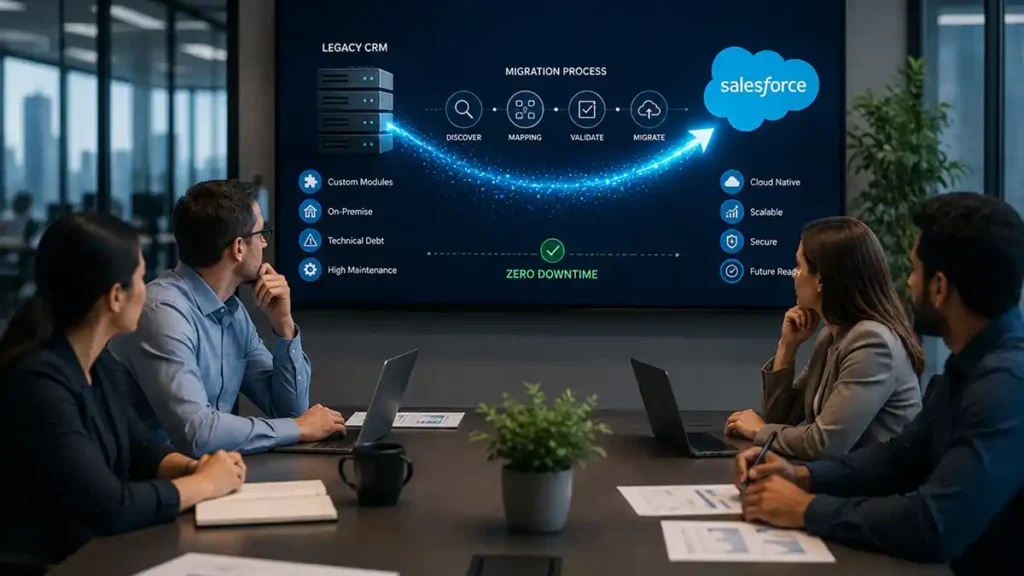
Techlumas Solutions Private Limited was engaged to migrate a legacy CRM system to Salesforce with a strict requirement: zero downtime, zero data loss, and no impact on ongoing business operations.
This is how the migration was successfully executed.
The Challenge
The client relied on a highly customized legacy CRM that was deeply integrated into core business functions, including sales operations, customer support workflows, financial tracking, and multiple third-party systems.
The primary risks included potential data loss during migration, system downtime affecting active users, integration failures, and internal resistance to adopting a new platform.
This was not a standard migration project. It required replacing a live system without interrupting business continuity.
The Strategy: Parallel System Migration
Instead of using a traditional cutover approach, a parallel migration strategy was implemented. This allowed both the legacy system and Salesforce to operate simultaneously during the transition period.
This approach ensured uninterrupted business operations, enabled real-time validation of the new system, and provided a reliable fallback option if required.
Execution Approach
The process began with a detailed audit of the existing CRM. This included analyzing data structures, custom workflows, integrations, and user roles. Based on this, a comprehensive mapping to Salesforce architecture was created.
Data migration was planned in structured phases. Rather than transferring all data at once, it was segmented and prioritized. Critical datasets were migrated first, ensuring better control and reduced risk.
A parallel Salesforce environment was then developed to replicate the functionality of the legacy system. This included custom objects, automation rules, and integrations, enabling real-world testing before full adoption.
To maintain consistency between both systems, a real-time synchronization mechanism was implemented. This ensured that any updates in one system were reflected in the other, maintaining complete data alignment throughout the transition.
User migration was handled incrementally. Teams were onboarded in phases, supported with training and feedback loops to ensure smooth adoption and usability improvements.
Once the system demonstrated stability and accuracy, the final transition was executed. Traffic was gradually shifted to Salesforce, and the legacy system was phased out without any disruption to operations.
Data Integrity and Security
To ensure reliability, multiple validation layers were implemented. Automated checks verified data accuracy during migration, while reconciliation processes ensured consistency across systems.
Backup mechanisms and rollback strategies were maintained throughout the project. Access controls were also enforced to ensure data security during and after migration.
The Outcome
The migration was completed with zero downtime and no data loss. Millions of records were transferred accurately, and users transitioned seamlessly to the new system.
The client benefited from improved system performance, enhanced scalability, and more advanced reporting and automation capabilities within Salesforce.
Key Takeaways
Enterprise migrations should avoid high-risk, single-step transitions. A parallel system approach significantly reduces operational risk and ensures continuity.
Data synchronization plays a critical role in maintaining system consistency during migration. Additionally, user adoption must be managed alongside technical execution to ensure long-term success.
Conclusion
Enterprise system migrations can be executed without disruption when approached with careful planning, structured execution, and risk mitigation strategies.
Techlumas Solutions Private Limited focuses on delivering reliable, scalable, and business-aligned technology solutions. Whether it is CRM migration, platform development, or digital transformation, the goal remains consistent: enabling growth without compromise.